DropProof vs Generic POD Software: More Than Just Proof of Delivery
Proof of delivery is an important part of every delivery operation. Businesses need to know that an order was delivered, when it happened, where it happened, and what evidence exists.
Generic POD software is designed primarily around this requirement.
It can help drivers capture things such as:
- Digital signatures
- Photos
- Delivery notes
- Timestamps
- GPS location
These capabilities can replace paper-based delivery confirmation and create a digital delivery record. Modern ePOD products commonly combine signatures, photos, timestamps, GPS information, and other delivery evidence.
But proof of delivery is only one part of the delivery operation.
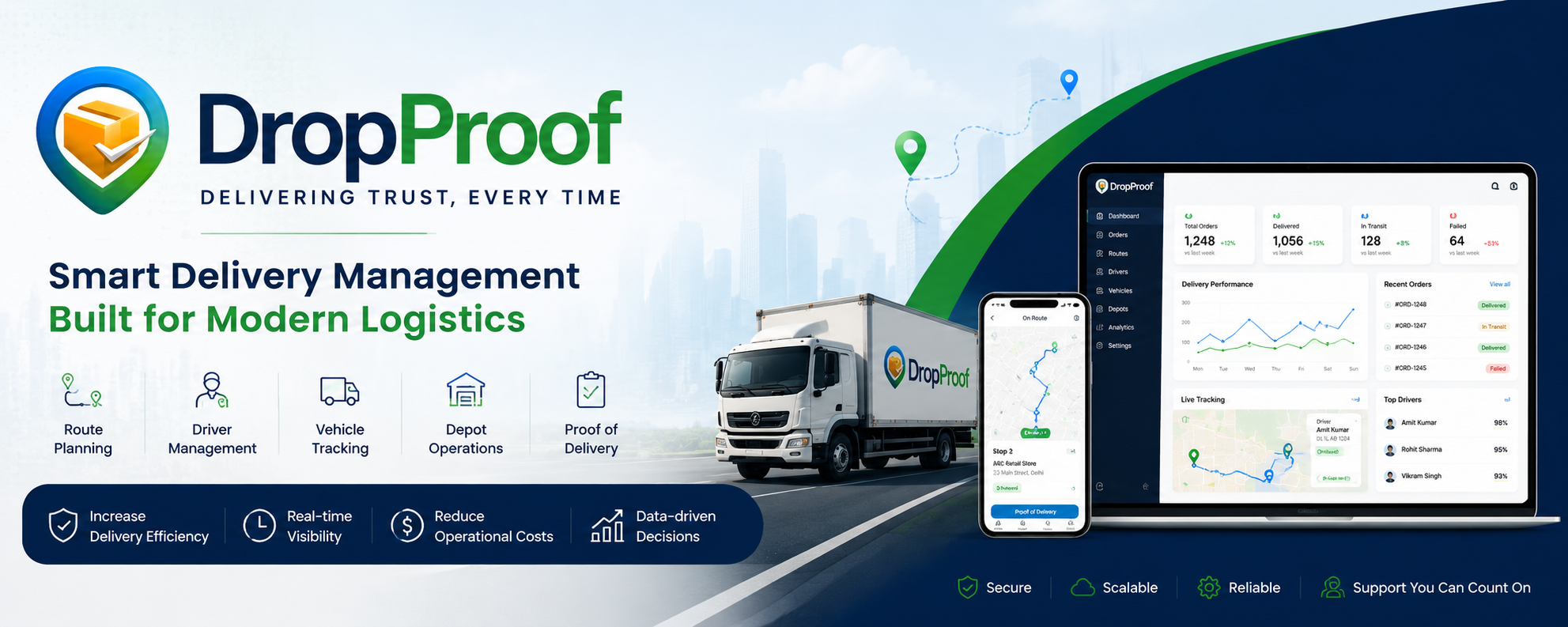
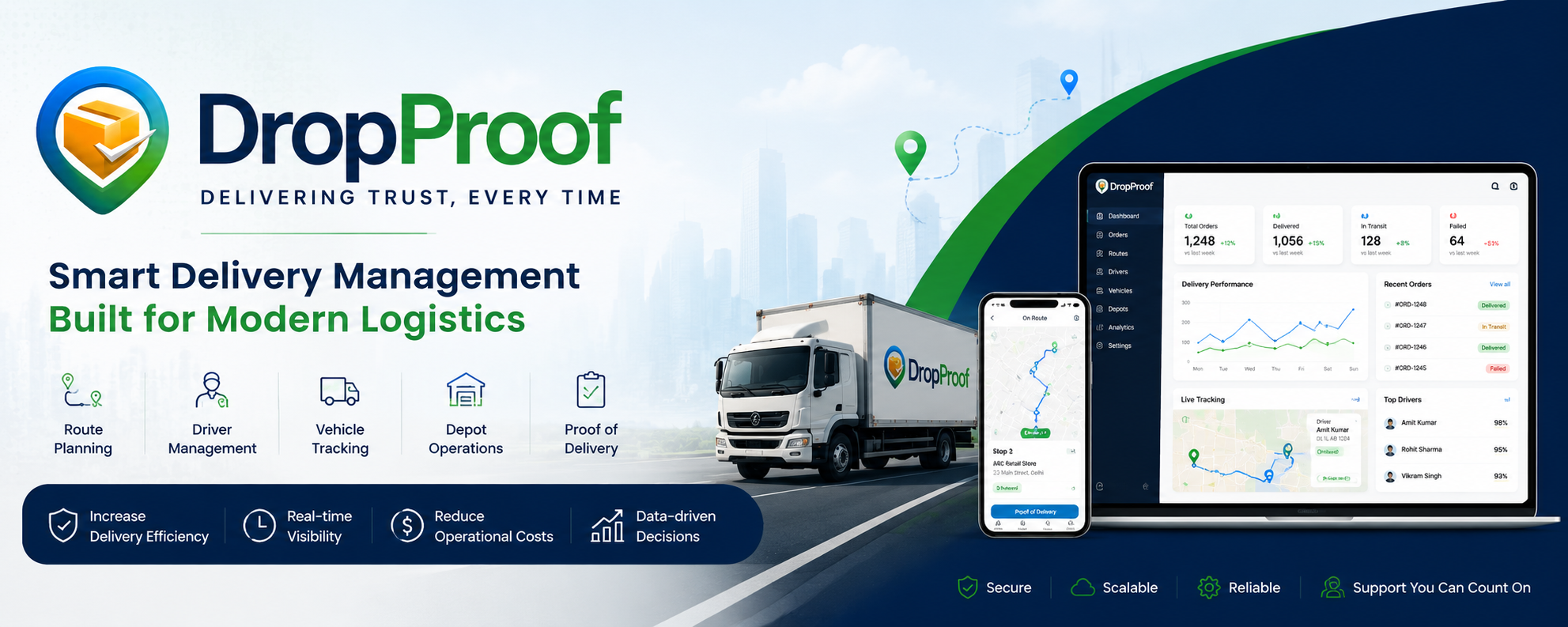
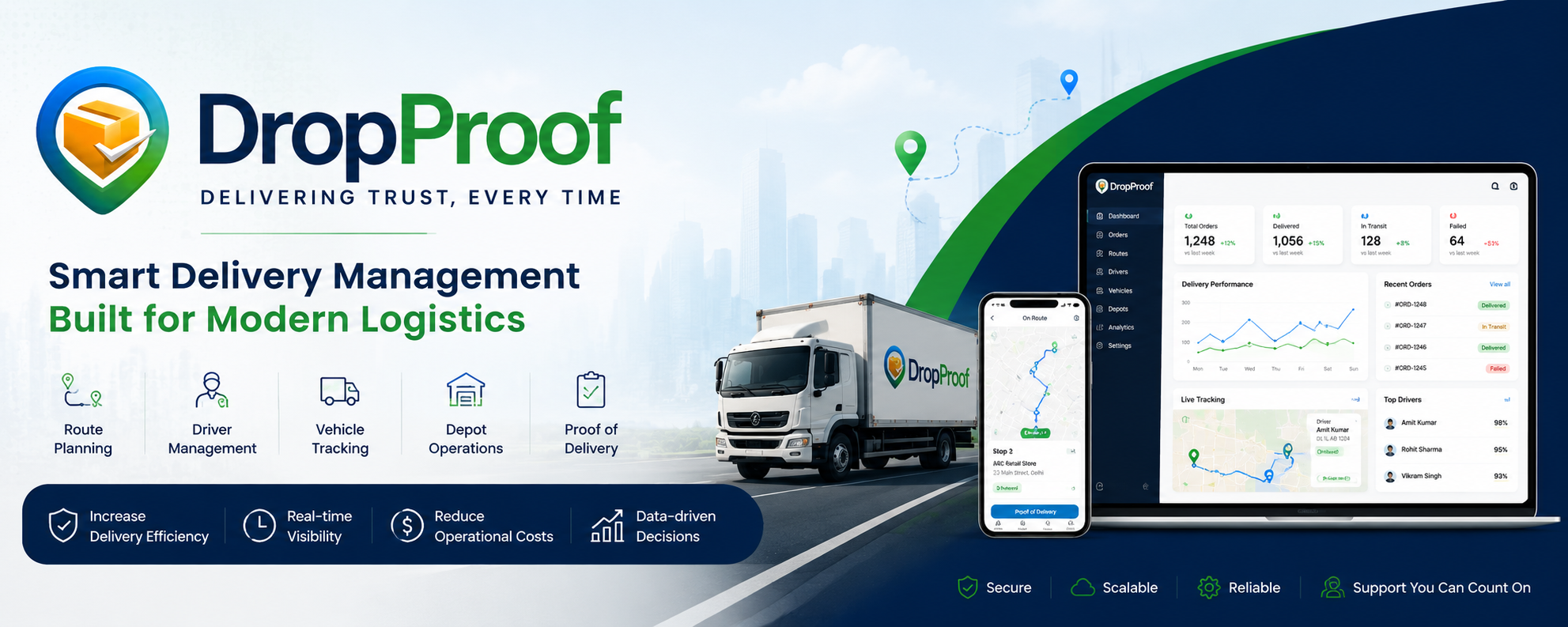
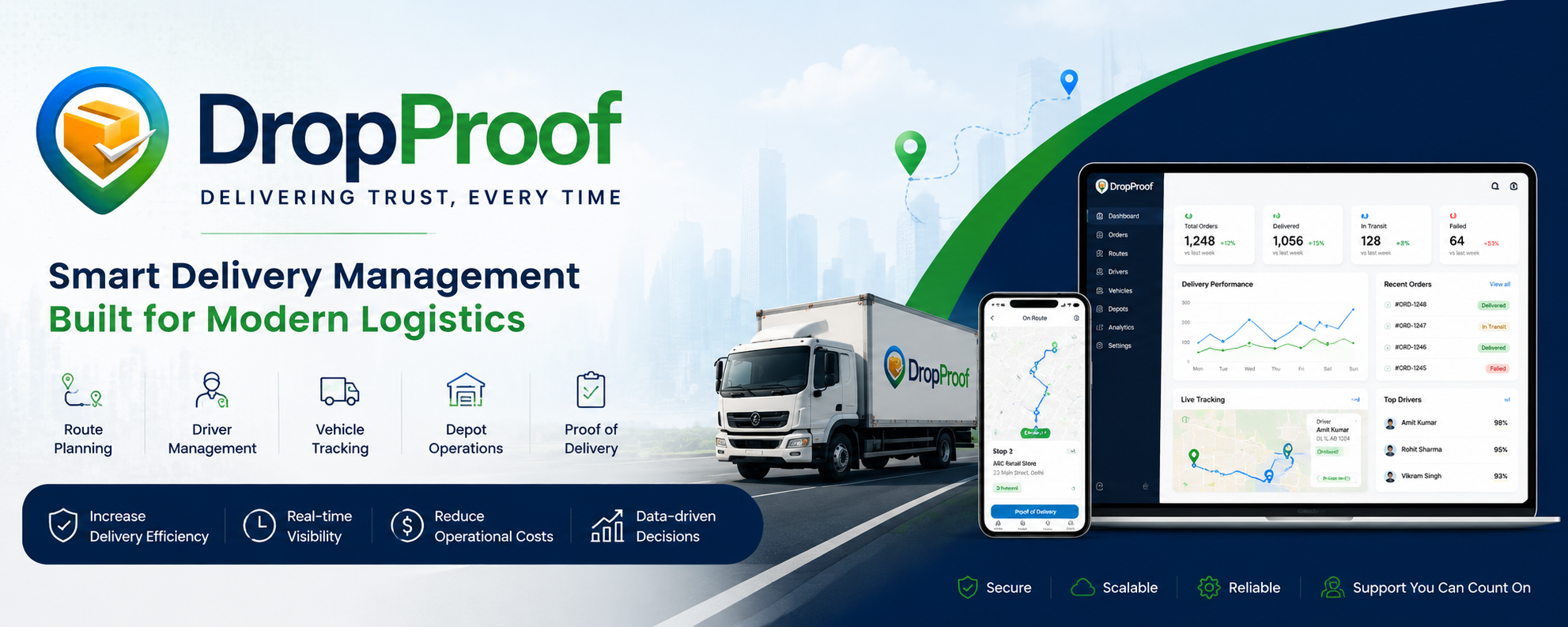
DropProof goes beyond capturing POD. It combines route planning, order management, driver management, live tracking, delivery execution, and digital proof of delivery in one platform.
The difference is simple:
Generic POD Software: Deliver → Capture Proof
DropProof: Order → Plan → Assign → Track → Deliver → Verify
DropProof vs Generic POD Software at a Glance
| Capability | DropProof | Generic POD Software |
|---|---|---|
| Order Management | ✅ | ⚠️ Depends |
| Manual Order Creation | ✅ | ⚠️ |
| Bulk Order Import | ✅ | ⚠️ |
| Route Planning | ✅ | ⚠️ / ❌ |
| Route Optimization | ✅ | ⚠️ / ❌ |
| Driver Management | ✅ | ⚠️ |
| Driver App | ✅ | ✅ |
| Driver Assignment | ✅ | ⚠️ |
| Real-Time Tracking | ✅ | ⚠️ |
| Delivery Status | ✅ | ✅ |
| Digital Signature | ✅ | ✅ |
| Photo Proof | ✅ | ✅ |
| GPS Verification | ✅ | ✅ / ⚠️ |
| Delivery Notes | ✅ | ✅ |
| Vehicle Management | ✅ | ❌ / ⚠️ |
| Depot Management | ✅ | ❌ / ⚠️ |
| Delivery Analytics | ✅ | ⚠️ |
| Route History | ✅ | ⚠️ |
| Digital POD Records | ✅ | ✅ |
| API / Webhooks | ✅ | Depends |
| End-to-End Delivery Workflow | ✅ | ❌ / Depends |
Generic POD software varies significantly. Some modern ePOD products also include route planning, tracking, and dispatch, so businesses should compare the actual capabilities of the specific product they are evaluating.
What Is Generic POD Software?
Generic Proof of Delivery software is primarily designed to digitize the delivery-confirmation process.
Instead of:
Paper Form → Signature → Driver Returns Paper → Office Processes Document
the driver can capture:
Signature → Photo → Timestamp → GPS → Digital Record
Modern ePOD systems commonly provide digital signatures, photos, timestamps, GPS information, notes, and sometimes barcode scanning or other verification methods.
This can reduce paperwork and make delivery evidence easier to access.
But the key question is:
Does the software only document the delivery, or does it help you manage the delivery itself?
What Is DropProof?
DropProof is a delivery management platform designed to manage the broader delivery operation.
It brings together:
- Orders
- Routes
- Drivers
- Vehicles
- Depots
- Live tracking
- Delivery execution
- Digital proof of delivery
- Analytics
- Integrations
DropProof describes its workflow around Plan → Execute → Verify, combining route optimization, real-time tracking, dispatch, and digital POD with photo, signature, and GPS verification.
The Biggest Difference
Imagine a dispatcher has 200 orders and 15 drivers.
A generic POD system might help after the deliveries happen:
"Driver delivered order #1045. Here is the signature and photo."
DropProof starts earlier:
Which driver should receive order #1045?
Which route should it be on?
What other stops should be grouped with it?
Where is the driver now?
Has the delivery been completed?
Where is the proof?
That's the difference between a POD tool and a delivery-management platform.
Order Management
Generic POD Software
Some POD products allow delivery jobs to be imported or created, but the depth of order-management functionality varies significantly.
The main purpose is usually to ensure the driver has enough information to complete and document the delivery.
DropProof
DropProof provides a dedicated order-management workflow.
Teams can:
- Create orders
- Import orders in bulk
- Export orders
- View order details
- Manage order status
- Assign orders to routes
This means the order doesn't exist separately from the delivery workflow.
Route Planning
This is one of the biggest differences.
Generic POD Software
A basic POD tool may simply provide the driver with a list of delivery jobs.
The dispatcher may still need another system—or manual processes—to determine:
- Which driver gets the orders
- Stop sequence
- Route structure
- Delivery windows
- Daily workload
Some modern POD platforms do include route planning, so this should be checked product by product.
DropProof
Route planning is part of the core platform.
The workflow can be:
Create Route → Select Orders → Add Stops → Assign Driver → Execute Route
DropProof also positions route optimization and scheduling alongside tracking and POD.
Driver Management
Generic POD Software
A generic POD solution may provide a driver app and allow drivers to receive jobs.
But driver-management depth varies between products.
DropProof
DropProof provides dedicated driver management.
Teams can:
- Add drivers
- Edit driver information
- View driver status
- Monitor availability
- Assign routes
- Track active deliveries
The driver isn't simply a user submitting POD—the driver is part of the complete delivery operation.
Real-Time Tracking
Generic POD Software
Some POD systems provide location tracking, while others focus primarily on delivery confirmation.
For example, modern ePOD platforms may combine GPS, timestamps, and real-time delivery updates.
But this isn't universal across generic POD products.
DropProof
Live tracking is built into the broader delivery workflow.
Operations teams can monitor:
- Drivers
- Routes
- Stops
- Delivery progress
- Delivery status
- ETA
DropProof specifically lists live tracking with ETA alongside route optimization and dynamic delivery updates.
Proof of Delivery
This is where both solutions overlap.
Generic POD Software
Typical digital POD capabilities include:
- Digital signature
- Photo proof
- Timestamp
- GPS location
- Notes
- Barcode scanning in some products
These features are common across modern ePOD platforms.
DropProof
DropProof also provides digital POD through:
- 📸 Photos
- ✍️ Signatures
- 📍 GPS verification
- ✅ Delivery confirmation
The difference is that POD is connected to the rest of the delivery record rather than being the only purpose of the platform.
Vehicle Management
Generic POD software generally isn't designed to be a complete fleet-management system.
Some platforms may support vehicle assignment or fleet-related information, but this varies.
DropProof includes vehicle management as part of its delivery operations.
Teams can manage:
- Vehicles
- Driver assignments
- Delivery operations
- Fleet information
This is useful when the business needs visibility beyond the POD itself.
Depot Management
DropProof also includes support for multiple teams and depots, allowing delivery operations to be structured around different operational locations.
A basic POD platform may not provide a dedicated depot-management workflow.
For businesses operating across multiple locations, this distinction becomes more important as delivery volume grows.
Analytics & Reporting
Generic POD Software
A POD platform may provide reports showing:
- Completed deliveries
- Failed deliveries
- POD records
- Driver activity
The depth depends on the platform.
DropProof
DropProof provides operational reporting around:
- Driver statistics
- Trip summaries
- Delivery activity
- Custom reports
- Data history
This lets teams analyze the delivery operation rather than only the proof documents.
Integrations
Generic POD products may offer APIs and integrations, but capabilities vary.
DropProof provides:
- REST API
- OAuth 2.0
- Webhooks
- External integrations
- Custom syncs
It also describes integrations with order systems, ERP, WMS, CRM, and other logistics tools.
This makes DropProof suitable as part of a larger logistics technology stack.
Generic POD vs DropProof: What Happens When a Delivery Fails?
This is another important distinction.
Imagine a driver reaches the destination but cannot complete the delivery.
Generic POD
The system may allow the driver to record:
Delivery Failed
and perhaps add a note or photo.
DropProof
The failed delivery can be part of the broader operational workflow.
The team can understand:
Order → Route → Driver → Stop → Delivery Status → Proof
That gives operations teams more context around the exception.
Generic POD vs DropProof: What Happens Before Delivery?
This is where the difference becomes very clear.
Generic POD
Usually focuses on:
Delivery → Proof
DropProof
Starts before the driver even leaves:
Order → Route → Driver → Stop → Navigation → Delivery → POD
That means DropProof is designed to manage the entire delivery lifecycle, not just the final confirmation.
When Is Generic POD Software Enough?
Generic POD software may be enough if your business already has a strong delivery-management system and only needs to digitize the final confirmation.
For example:
Existing TMS → Driver → Generic POD
If your existing system already handles:
- Orders
- Routes
- Drivers
- Tracking
- Dispatch
then adding a dedicated POD tool may make sense.
When Should You Choose DropProof?
DropProof becomes more relevant when you want multiple delivery functions in one platform.
Consider DropProof if you need:
- Order management
- Route planning
- Route optimization
- Driver management
- Driver assignment
- Vehicle management
- Depot management
- Live tracking
- Delivery execution
- Digital POD
- Analytics
- API integrations
DropProof combines these capabilities rather than requiring separate systems for each part of the delivery process.
DropProof + Existing POD Software
You don't necessarily have to replace an existing POD system immediately.
If your company already has a POD tool that works well, the better question is:
Does it cover the operational gaps we currently have?
If the answer is no, DropProof can potentially become the broader delivery-management layer.
The ideal architecture could look like:
ERP / OMS / WMS
↓
DropProof
↓
Routes + Drivers + Tracking
↓
Delivery
↓
Digital POD
↓
ERP / CRM / Billing
DropProof supports API, webhook, and external integration capabilities for connecting with existing systems.
Who Is Generic POD Software Best For?
Generic POD software can be a good fit for businesses that:
- Already have a TMS
- Already have route planning
- Already have driver management
- Only need digital POD
- Want to eliminate paper delivery documents
- Need signatures and photos
- Need basic delivery confirmation
Who Is DropProof Best For?
DropProof is better suited to businesses that want to manage the delivery operation itself.
🚚 Logistics Companies
Manage routes, drivers, vehicles, and POD in one platform.
📦 Distribution Businesses
Connect orders directly to delivery execution.
🛒 E-commerce Delivery Teams
Manage last-mile operations and delivery visibility.
🏭 FMCG & Wholesale
Coordinate high-volume, multi-stop delivery operations.
🚛 Growing Fleets
Move from disconnected tools to a centralized delivery-management platform.
DropProof vs Generic POD Software: Which Should You Choose?
Choose Generic POD Software if you primarily need:
- Digital signatures
- Delivery photos
- Delivery timestamps
- GPS proof
- Delivery notes
- Basic POD records
Choose DropProof if you need:
- Order management
- Route planning
- Route optimization
- Driver assignment
- Driver management
- Vehicle management
- Depot management
- Real-time tracking
- Delivery status
- Digital POD
- Analytics
- API and webhooks
Final Verdict
Generic POD software answers one important question:
"Can we prove this delivery happened?"
DropProof answers a much bigger set of questions:
"What needs to be delivered?"
"Which route should it be on?"
"Which driver is handling it?"
"Where is the driver?"
"Was the delivery completed?"
"Where is the proof?"
DropProof brings planning, execution, tracking, and verification together in one delivery-management platform.
If your only goal is to replace paper POD, a dedicated POD solution may be enough.
But if you're looking to manage the entire delivery operation, DropProof offers a broader workflow:
Plan → Assign → Track → Deliver → Verify
Ready to manage more than just POD?
Plan smarter. Manage deliveries. Capture proof.
[Book a Demo] | [Explore DropProof]