DropProof vs Custom-Built Delivery Apps
When a delivery business wants to digitize its operations, there are usually two choices:
Build your own delivery application or use an existing delivery-management platform like DropProof.
Building custom software gives you complete control over the product, workflows, integrations, and user experience. But it also means your team has to design, develop, test, deploy, secure, and continuously maintain the entire system.
A ready-made platform takes a different approach.
Instead of spending months building core delivery infrastructure, businesses can start with an existing platform and configure it around their operations.
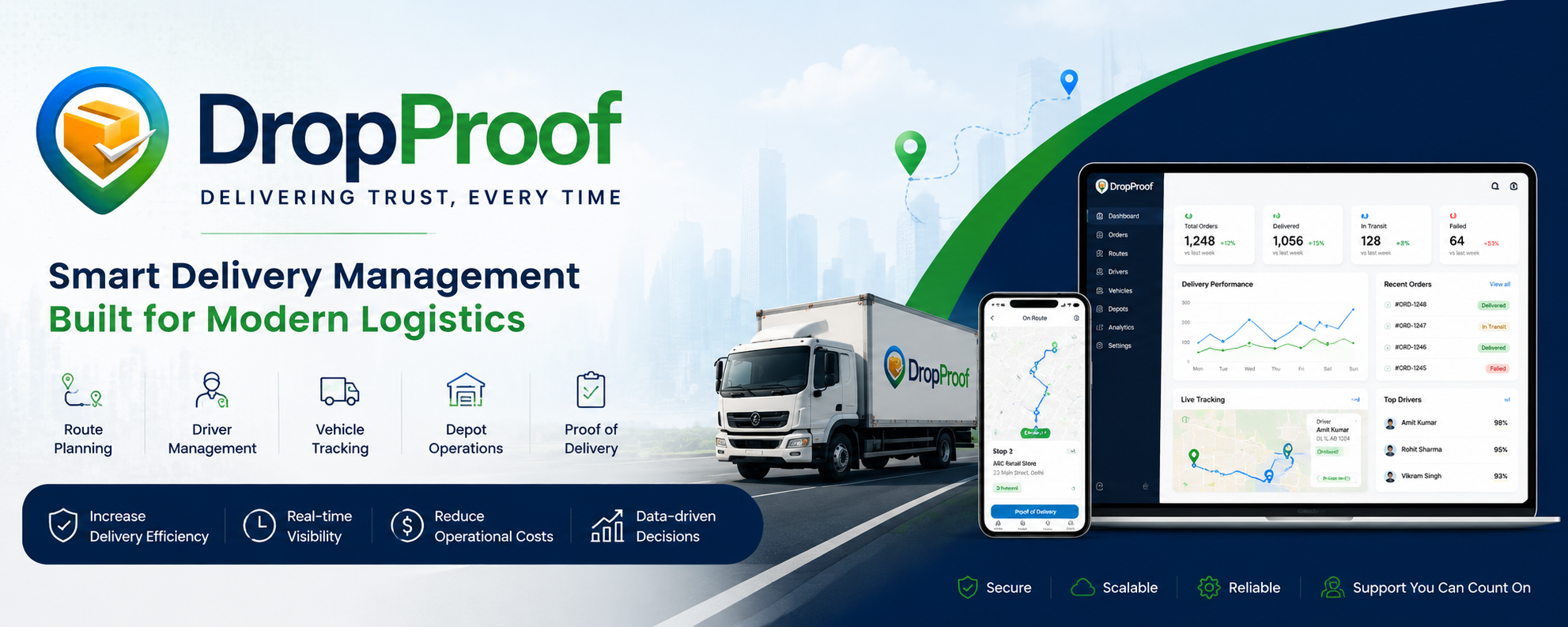
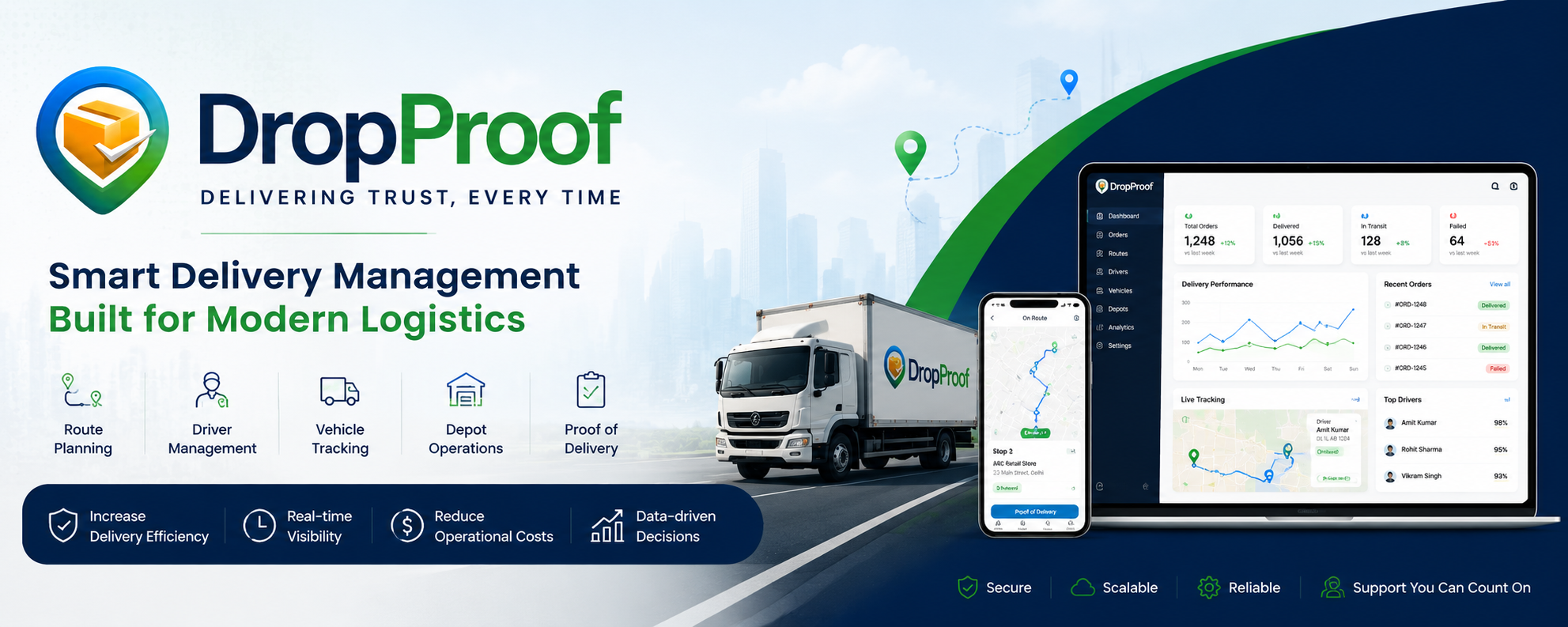
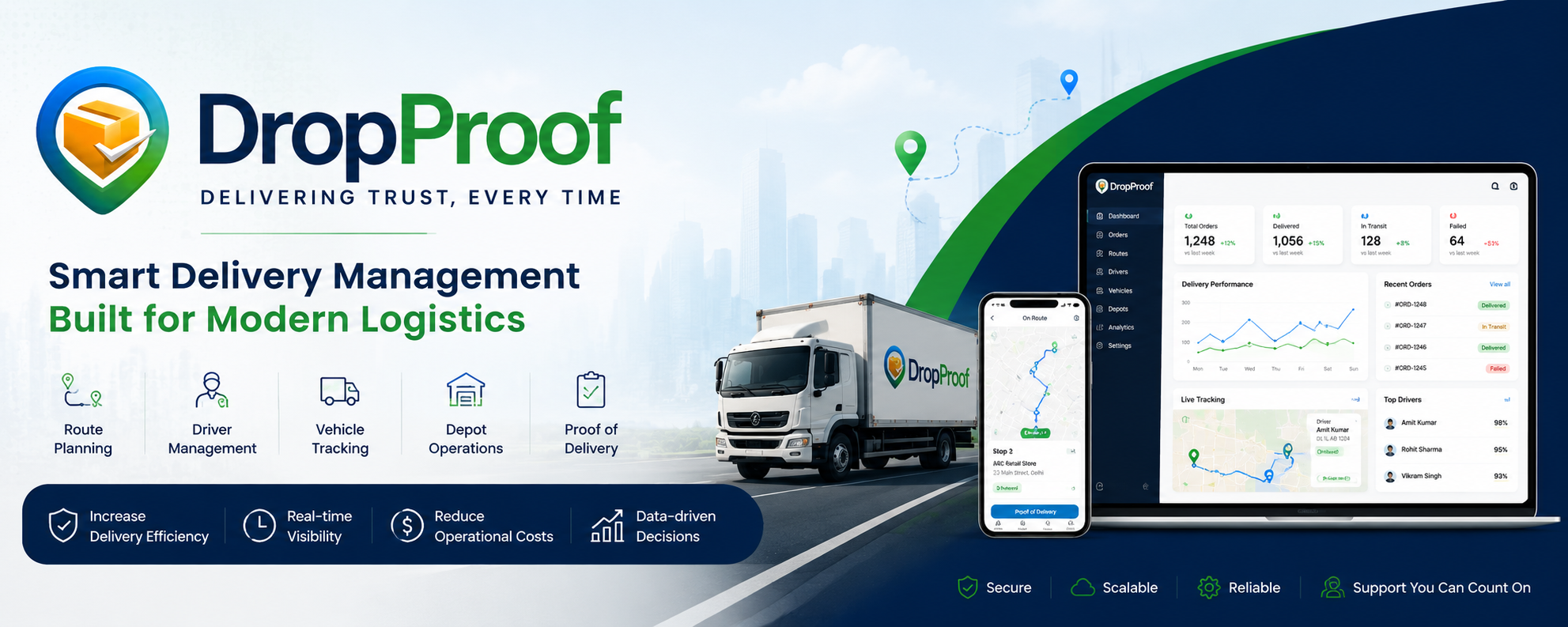
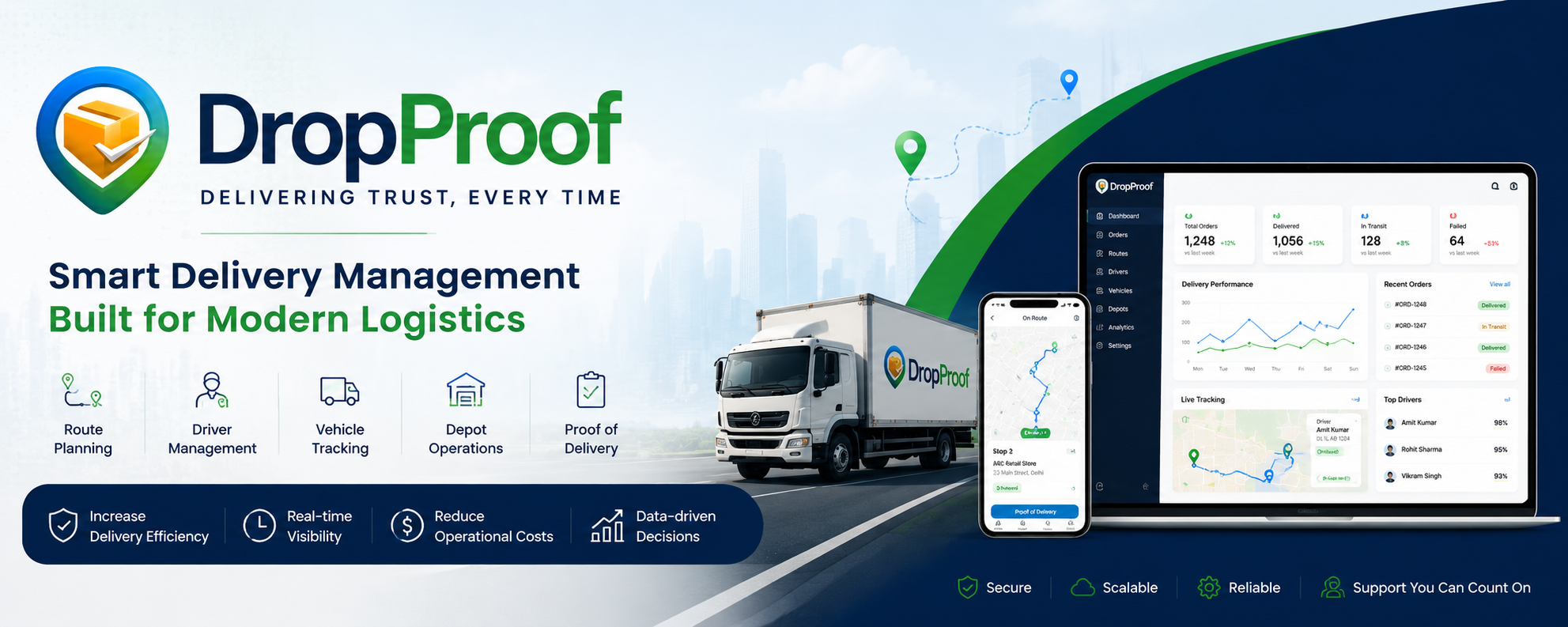
DropProof brings together order management, route planning, driver management, vehicle management, tracking, delivery execution, and digital proof of delivery in one platform.
The fundamental choice is:
Custom App: Build everything around your exact requirements.
DropProof: Start with an existing delivery platform and get your operation running faster.
DropProof vs Custom-Built Delivery Apps at a Glance
| Capability | DropProof | Custom-Built App |
|---|---|---|
| Initial Development | Ready to use | Requires development |
| Time to Launch | Faster | Longer |
| Customization | Configuration + supported customization | Full control |
| Order Management | ✅ | Must build |
| Route Planning | ✅ | Must build |
| Driver Management | ✅ | Must build |
| Driver App | ✅ | Must build |
| Real-Time Tracking | ✅ | Must build |
| Vehicle Management | ✅ | Must build |
| Depot Management | ✅ | Must build |
| Proof of Delivery | ✅ | Must build |
| Digital Signatures | ✅ | Must build |
| Delivery Photos | ✅ | Must build |
| GPS Verification | ✅ | Must build |
| Analytics | ✅ | Must build |
| API / Integrations | ✅ | Must develop |
| Infrastructure | Managed platform | Your responsibility |
| Updates | Product-managed | Your team |
| Bug Fixes | Product-managed | Your team |
| Security Maintenance | Platform-managed | Your team |
| Full Source-Code Control | ❌ | ✅ |
| Unique Workflow Control | Limited by platform | ✅ |
| Upfront Engineering Effort | Lower | Higher |
What Is a Custom-Built Delivery App?
A custom-built delivery app is software developed specifically for one company's delivery operation.
The business can define:
- How orders are created
- How routes are generated
- How drivers are assigned
- How vehicles are managed
- How delivery statuses work
- What the driver app looks like
- What customers see
- What integrations are required
- What reports are generated
The biggest advantage is control.
The biggest disadvantage is that the business also owns the complexity.
A modern delivery platform may require route optimization, driver dispatch, live GPS, customer notifications, driver applications, POD, analytics, and integrations.
What Is DropProof?
DropProof is a ready-made delivery-management platform designed to manage the operational delivery lifecycle.
The workflow is:
Order → Route → Driver → Track → Deliver → Verify
Instead of building each component independently, businesses can use an existing platform for their delivery operations.
The Real Cost of Building a Custom Delivery App
The biggest mistake businesses make is looking only at the initial development cost.
A custom delivery platform also requires ongoing investment in:
- Cloud infrastructure
- Maps and routing APIs
- Database infrastructure
- Mobile app maintenance
- Backend maintenance
- Security updates
- Bug fixes
- Monitoring
- DevOps
- Customer support
- New feature development
Industry estimates for custom last-mile software vary widely depending on scope. One recent estimate puts a custom MVP covering dispatch, route optimization, POD, and SLA tracking at roughly $90,000–$180,000, while a full platform can be substantially more.
These are third-party estimates, not DropProof pricing, and actual costs depend heavily on requirements.
Development Time
Custom-Built App
A custom system needs to go through:
Requirements → UX/UI → Architecture → Development → Testing → Deployment → Training
And development doesn't stop after launch.
New requirements continue to appear.
For example:
"We need WhatsApp notifications."
Then:
"We need multiple depots."
Then:
"We need better route optimization."
Then:
"We need customer tracking."
Each requirement can mean another development cycle.
DropProof
With a ready-made platform, the core delivery infrastructure already exists.
The business can focus more on:
Configuration → Data Setup → Team Onboarding → Operations
rather than building the entire system from scratch.
Ready-made delivery platforms can significantly shorten the path to deployment compared with building routing, dispatch, driver apps, and POD independently.
Route Planning
Custom-Built App
You need to build or integrate:
- Mapping
- Geocoding
- Route calculation
- Route optimization
- Traffic data
- Time windows
- Vehicle constraints
- Driver constraints
- Route re-optimization
And then maintain those integrations.
DropProof
Route planning is already part of the delivery workflow.
Operations teams can create routes, organize stops, assign drivers, and manage delivery execution.
This means the business doesn't have to start by engineering its own routing infrastructure.
Driver App
A driver application sounds simple until you start listing everything it needs to handle.
A production driver app may require:
- Login
- Assigned routes
- Delivery stops
- Navigation
- Order details
- Status updates
- Photos
- Signatures
- GPS
- Notifications
- Failed deliveries
- Offline handling
- Synchronization
- Background location
Custom development means your team owns all of this.
With DropProof, the driver workflow is already part of the platform.
Real-Time GPS Tracking
Real-time tracking is another area where custom development becomes complicated.
A custom system needs:
Mobile GPS → Background Location → API → Server → Database → WebSocket/Realtime Layer → Dashboard → Maps
You also need to consider:
- Battery usage
- Location accuracy
- Connectivity
- Permissions
- Background restrictions
- Data volume
- GPS failures
DropProof provides delivery tracking as part of its operational workflow.
This means teams can focus on managing deliveries rather than building the tracking infrastructure itself.
Proof of Delivery
Custom-Built App
You need to develop:
- Digital signatures
- Photo capture
- GPS verification
- Timestamping
- Delivery notes
- POD storage
- POD retrieval
- User permissions
You also need to determine how that data will be synchronized with your ERP, CRM, or other systems.
DropProof
Digital POD is already part of the delivery workflow.
DropProof supports:
- 📸 Photos
- ✍️ Signatures
- 📍 GPS verification
- ✅ Delivery confirmation
This allows delivery proof to remain connected to the order and delivery record.
Order Management
Custom-Built App
You need to define and build your own order model.
That includes:
- Order creation
- Order import
- Order status
- Customer details
- Delivery addresses
- Items
- Assignment
- Order history
You then need to maintain this system as your business requirements change.
DropProof
Order management is already integrated with the delivery workflow.
The operation can move from:
Order → Route → Driver → Delivery
without having to build the entire order-management layer first.
Vehicle Management
Custom development means building your own vehicle-management module.
You may need:
- Vehicle records
- Vehicle status
- Vehicle assignment
- Capacity
- Driver relationships
- Fleet reporting
DropProof provides vehicle management as part of the delivery operation.
Depot Management
If your company operates multiple depots, a custom application needs to model relationships between:
Depot → Orders → Routes → Drivers → Vehicles
You also need rules around which orders belong to which depot and how routes are planned from each location.
DropProof includes a dedicated depot workflow, making this part of the operational structure rather than another custom module that needs to be developed.
Analytics & Reporting
Custom-Built App
You need to decide what you want to measure:
- Delivery success rate
- Driver performance
- Route efficiency
- Delivery time
- Failed deliveries
- POD completion
- Depot performance
Then build the database queries, dashboards, exports, permissions, and reporting system.
DropProof
Delivery analytics and operational reporting are already part of the platform.
This lets businesses focus on using delivery data rather than first building the reporting infrastructure.
Integrations
This is one area where custom development can have a major advantage.
If you have a very unusual integration requirement, custom development gives you complete control.
For example:
ERP → Custom Middleware → Delivery Engine → Driver App → Customer Portal
You can design the architecture exactly around your business.
DropProof takes a more standard integration approach with APIs and webhooks, allowing it to connect with external systems while keeping the delivery platform separate.
Customization
Custom-Built App
This is where custom software wins.
You control:
- UI
- UX
- Business rules
- Data model
- Workflow
- Permissions
- Integrations
- Branding
- Automation
If your business has highly unusual logistics requirements, this flexibility can be extremely valuable.
DropProof
DropProof gives you a ready-made delivery-management workflow.
You get speed and simplicity, but you are working within the capabilities and configuration options of the platform.
Maintenance
This is often overlooked.
With custom software, someone needs to maintain:
Backend
- Servers
- Databases
- APIs
- Authentication
- Security
Mobile
- Android updates
- iOS updates
- App-store requirements
- Device compatibility
Infrastructure
- Cloud hosting
- Monitoring
- Backups
- Scaling
- Security
Integrations
- Maps
- Messaging
- ERP
- CRM
- Payment systems
Product
- Bugs
- New features
- User requests
- Performance improvements
Buying a delivery platform shifts much of this ongoing responsibility to the software provider.
Custom-Built App vs DropProof: Total Ownership
The real comparison isn't simply:
Build Cost vs Subscription
It's:
Total Cost of Ownership
A custom platform may involve:
Development + Infrastructure + APIs + Maintenance + Engineering Team + Support + Security + Future Development
A ready-made platform generally involves:
Subscription + Configuration + Integration + Training
For many businesses, the second model can be easier to budget and operate.
When Should You Build Custom?
Custom development can make sense when:
Your workflow is highly unique
Your delivery operation has rules that standard platforms can't support.
You have a strong engineering team
You already have developers who can build and maintain the platform.
The software itself is your competitive advantage
You aren't simply using software internally—the technology is part of your business model.
You need complete ownership
You require full control over:
- Source code
- Architecture
- Data model
- Infrastructure
- Product roadmap
You have complex integrations
Your operation depends on proprietary systems that require deep customization.
When Should You Choose DropProof?
DropProof can make more sense when:
You want to launch quickly
You don't want to spend months building basic delivery infrastructure.
You want predictable operations
You'd rather use an existing platform than maintain an entire engineering stack.
Your workflow is fairly standard
Your requirements revolve around:
Orders → Routes → Drivers → Tracking → Delivery → POD
You don't want to build a driver app
The driver workflow is already part of the platform.
You want to reduce engineering overhead
Your team can focus on the actual logistics business instead of maintaining delivery infrastructure.
The Hybrid Approach
You don't always have to choose completely between build and buy.
A practical architecture can be:
Your Existing Systems
↓
DropProof
↓
Driver + Route + Tracking + POD
↓
Your ERP / CRM / Customer Systems
This gives the business a ready-made delivery engine while allowing custom systems to remain around it.
This "buy + integrate/customize" approach is commonly recommended when the core delivery workflow is standard but the business has specific integrations or unique requirements.
DropProof vs Custom-Built Delivery App: Quick Comparison
| Factor | DropProof | Custom-Built |
|---|---|---|
| Time to Launch | ⭐⭐⭐⭐⭐ | ⭐⭐ |
| Initial Engineering | Low | High |
| Customization | ⭐⭐⭐ | ⭐⭐⭐⭐⭐ |
| Route Management | ✅ | Build |
| Driver App | ✅ | Build |
| GPS Tracking | ✅ | Build |
| Digital POD | ✅ | Build |
| Vehicle Management | ✅ | Build |
| Depot Management | ✅ | Build |
| Integrations | Supported APIs/Webhooks | Fully custom |
| Maintenance | Lower internal burden | Your responsibility |
| Source Code Ownership | ❌ | ✅ |
| Unique Workflows | Limited by platform | ✅ |
| Scalability | Platform-dependent | Fully controlled |
| Engineering Team Required | Lower | Higher |
Who Is DropProof Best For?
🚚 Logistics Companies
Get a delivery platform without building one from scratch.
📦 Distribution Businesses
Manage orders, routes, drivers, and POD in one system.
🛒 E-commerce Delivery Teams
Launch and scale last-mile operations faster.
🏭 FMCG & Wholesale
Manage multi-stop delivery operations without building an internal logistics platform.
🚛 Growing Delivery Fleets
Move away from spreadsheets, WhatsApp, and manual workflows without starting a large software-development project.
Who Is Custom Development Best For?
Custom development may be the better option for:
- Large enterprises with highly specialized workflows
- Businesses with proprietary logistics algorithms
- Companies building technology as their core product
- Organizations requiring complete source-code ownership
- Operations with highly specific compliance requirements
- Businesses with a large internal engineering organization
DropProof vs Custom-Built Delivery Apps: Which Should You Choose?
Choose DropProof if you want:
- Faster implementation
- Lower initial engineering effort
- Route planning
- Driver management
- Driver app
- Real-time tracking
- Vehicle management
- Depot management
- Digital POD
- Delivery analytics
- API integrations
- Less ongoing software maintenance
Build Custom if you need:
- 100% workflow control
- Full source-code ownership
- Proprietary logistics algorithms
- Highly specialized business rules
- Deep custom integrations
- A completely unique user experience
- Technology that itself is your competitive advantage
Final Verdict
Building custom software gives you maximum control. DropProof gives you a faster path to running your delivery operation.
The question isn't simply:
"Can we build it?"
Of course you can—if you have the right engineering resources, budget, and time.
The better question is:
"Should we spend our engineering resources building delivery infrastructure that already exists?"
If your core requirements are:
Plan → Assign → Track → Deliver → Verify
a ready-made delivery platform can get you operational significantly faster than building every component yourself.
If your logistics workflow is genuinely unique and the software itself is a competitive advantage, custom development may make more sense.
For many growing delivery businesses, the practical middle ground is:
Use DropProof for standard delivery operations and customize only the parts that genuinely differentiate your business.
Ready to skip months of development?
Start with a delivery platform built for the workflow you already need.
[Book a Demo] | [Explore DropProof]