DropProof vs Existing TMS: Add Modern Delivery Execution Without Replacing Your TMS
Many logistics companies already have a Transportation Management System (TMS) in place.
A TMS can be the central system for transportation planning, carrier management, shipment execution, freight costs, tracking, and other transportation processes.
But having a TMS doesn't always mean every part of the last-mile delivery workflow is handled efficiently.
Drivers still need to receive routes. Dispatchers need to manage stops. Operations teams need live visibility. Customers may need delivery updates. And every completed delivery needs reliable proof.
This is where DropProof can complement an existing TMS.
Instead of replacing your existing system, DropProof can act as the delivery execution layer connecting your transportation system with drivers and the final delivery.
Existing TMS → DropProof → Driver → Customer
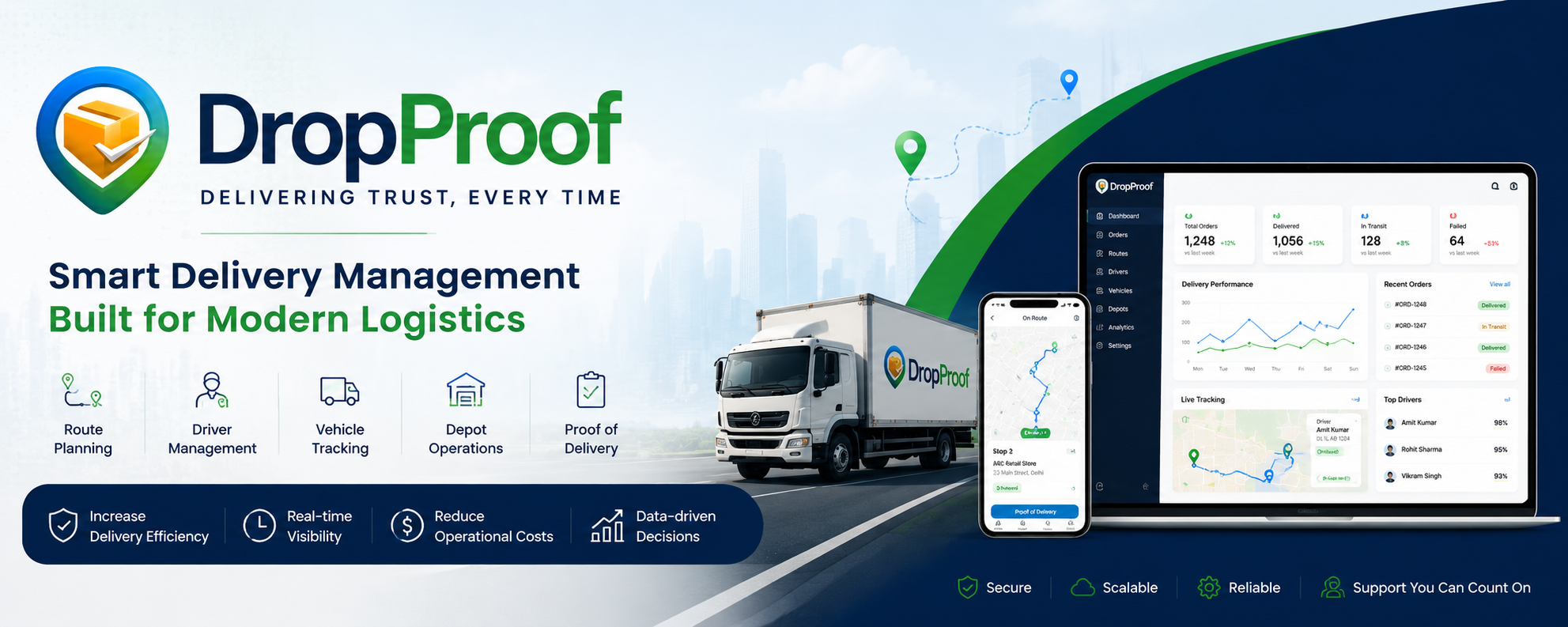
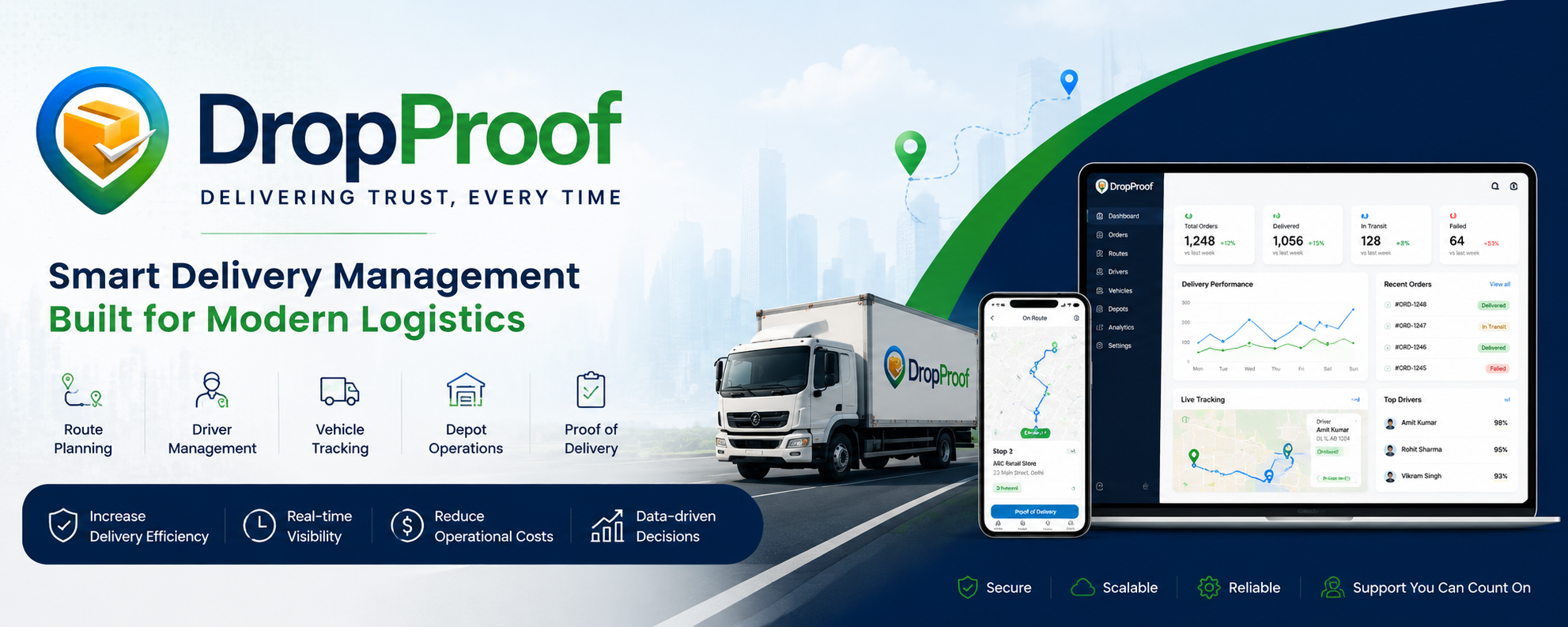
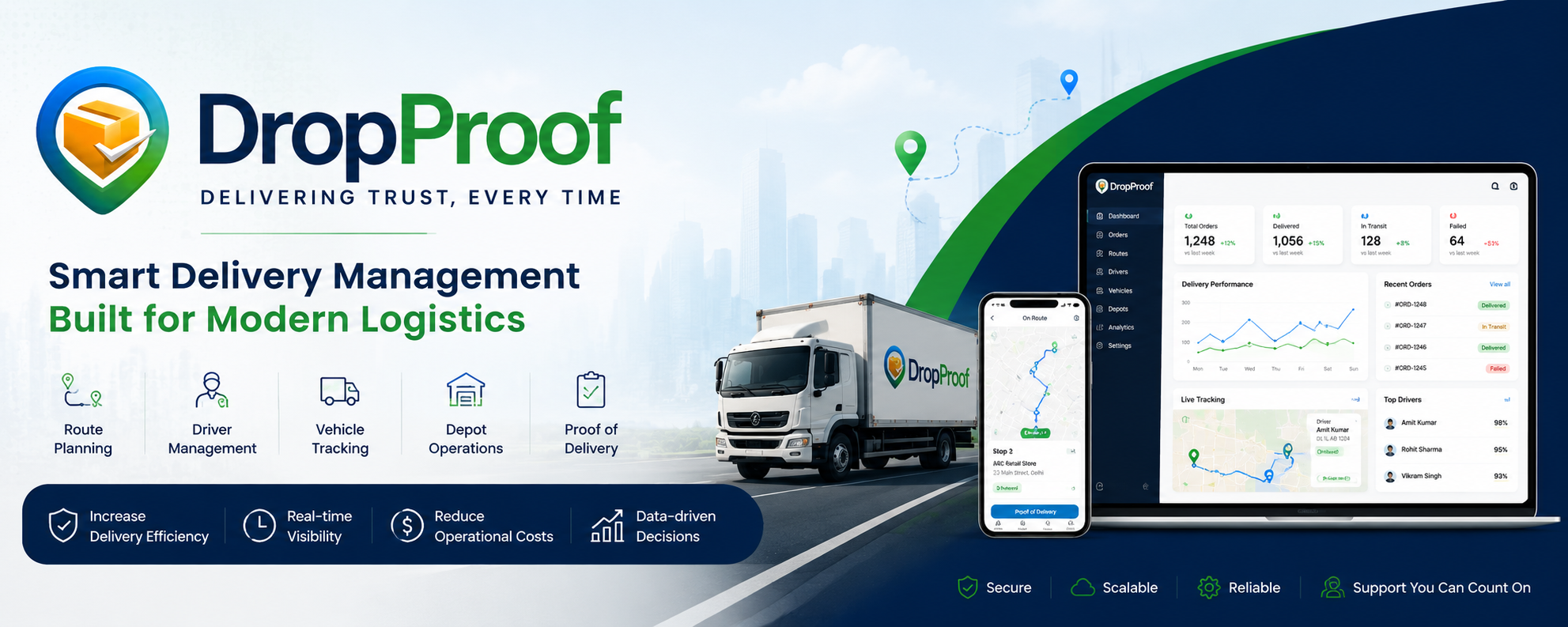
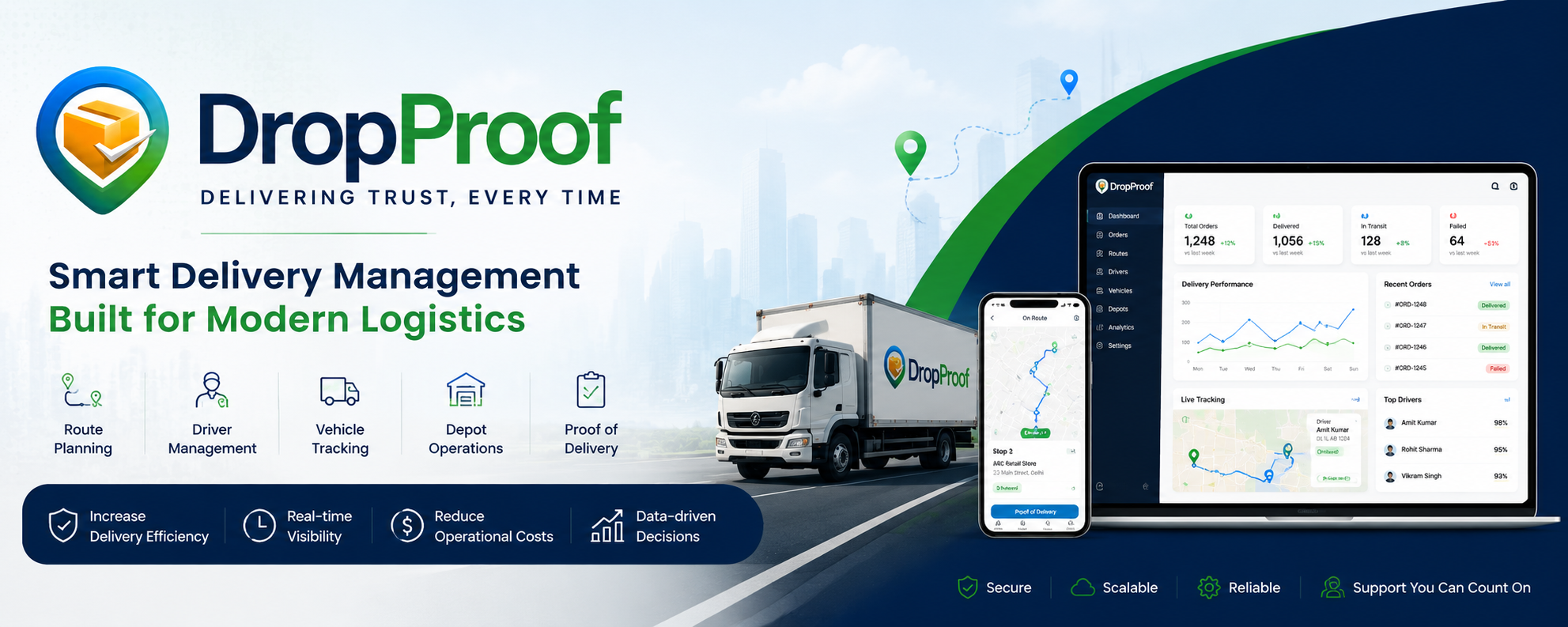
DropProof provides route planning, driver management, real-time tracking, dynamic delivery updates, and digital proof of delivery.
DropProof vs Existing TMS at a Glance
| Capability | Existing TMS | DropProof |
|---|---|---|
| Transportation Planning | ✅ | ⚠️ Delivery-focused |
| Carrier Management | ✅ | — |
| Freight Rate Management | ✅ | — |
| Shipment Booking | ✅ | — |
| Freight Settlement | ✅ | — |
| Order Intake | ✅ | ✅ |
| Delivery Route Planning | ✅/⚠️ | ✅ |
| Route Optimization | ✅/⚠️ | ✅ |
| Driver Management | ⚠️ | ✅ |
| Driver App | ⚠️ | ✅ |
| Live Driver Tracking | ✅/⚠️ | ✅ |
| Delivery Status | ✅ | ✅ |
| Dynamic Delivery Updates | ⚠️ | ✅ |
| Digital POD | ✅/⚠️ | ✅ |
| Delivery Photos | ⚠️ | ✅ |
| Digital Signatures | ⚠️ | ✅ |
| GPS Verification | ⚠️ | ✅ |
| Vehicle Management | ✅/⚠️ | ✅ |
| Depot Management | ⚠️ | ✅ |
| Delivery Analytics | ✅ | ✅ |
| API | Usually | ✅ |
| Webhooks | Depends | ✅ |
| Replace Existing TMS | — | ❌ Not necessarily |
Important: TMS capabilities vary significantly between products. The table above describes common TMS functionality rather than every TMS on the market.
What Is an Existing TMS?
A Transportation Management System is software used to plan, execute, and optimize the movement of goods.
Depending on the platform, a TMS can handle:
- Transportation planning
- Carrier selection
- Rate management
- Shipment booking
- Load planning
- Route optimization
- Shipment tracking
- Freight documentation
- Freight billing
- Settlement
- Transportation analytics
TMS platforms commonly integrate with ERP and WMS systems to exchange order, inventory, shipment, and transportation information.
For many organizations, the TMS is an important part of the broader supply-chain technology stack.
What Is DropProof?
DropProof is a delivery management platform focused on the execution and verification of deliveries.
It helps teams:
- Plan delivery routes
- Manage drivers
- Assign deliveries
- Track drivers
- Monitor delivery progress
- Manage vehicles and depots
- Capture digital proof of delivery
- Connect delivery data with other systems
DropProof's platform specifically describes integrations with eCommerce, ERP, WMS, CRM, APIs, and webhooks, making it possible to connect the delivery layer with an existing logistics ecosystem.
The Key Difference
The simplest way to understand the difference is:
TMS
"How should we move this shipment?"
DropProof
"How do we execute and verify this delivery?"
A TMS may determine the transportation plan.
DropProof can take the delivery workload and turn it into an operational workflow for drivers and dispatchers.
How DropProof Can Work With Your Existing TMS
You don't necessarily have to rip out your existing TMS.
Instead, the systems can work together.
Step 1 — TMS Creates Shipment
Your existing TMS handles the transportation or shipment process.
↓
Step 2 — Delivery Data Goes to DropProof
Order and delivery information can be sent to DropProof through API, webhooks, or another supported integration. DropProof specifically provides REST API, OAuth 2.0, webhooks, and external integrations.
↓
Step 3 — DropProof Plans Delivery
DropProof organizes the delivery workload into routes and stops.
↓
Step 4 — Driver Receives Route
The driver accesses assigned deliveries through the driver workflow.
↓
Step 5 — Driver Executes Delivery
The driver navigates through the assigned stops and updates delivery progress.
↓
Step 6 — DropProof Captures POD
The driver captures delivery proof through supported digital workflows, including photo, signature, and GPS verification.
↓
Step 7 — Delivery Data Goes Back
Delivery status and POD information can be pushed back to connected systems.
This creates a connected workflow:
TMS → DropProof → Driver → Delivery → POD → TMS
Why Not Just Use the TMS?
If your existing TMS already provides everything your drivers and delivery teams need, you may not need another system.
But many organizations have a gap between transportation management and last-mile execution.
For example, your TMS might already handle:
- Shipment planning
- Carrier selection
- Freight costs
- Load planning
- Transportation tracking
But your delivery team may still need:
- Better driver workflows
- Dedicated delivery routes
- Mobile delivery execution
- Live driver visibility
- Digital POD
- Delivery photos
- Digital signatures
- GPS verification
- Dynamic delivery updates
That's where a specialized delivery layer can add value.
1. Keep Your Existing TMS
One of the biggest advantages of this approach is that you don't necessarily have to replace your existing investment.
Your existing TMS can remain the system for transportation management.
DropProof can focus on the delivery execution layer.
This can be particularly useful for organizations that have already invested heavily in their transportation technology.
2. Improve Last-Mile Execution
A TMS may manage the transportation network.
DropProof focuses specifically on what happens when the delivery actually needs to happen.
That means:
Route → Driver → Stop → Delivery → POD
can be managed through a dedicated delivery workflow.
3. Give Drivers a Dedicated Workflow
Instead of expecting drivers to work through complex enterprise systems, DropProof provides a mobile-first driver workflow.
The driver can receive assigned deliveries, navigate stops, complete deliveries, and capture proof.
This creates a cleaner operational experience for the people actually executing the delivery.
4. Real-Time Delivery Visibility
DropProof provides live tracking with ETA and delivery visibility as part of its platform.
This allows operations teams to monitor:
- Active drivers
- Routes
- Stops
- Delivery progress
- Delivery status
Instead of relying only on shipment-level visibility, teams can get visibility into the actual delivery operation.
5. Digital Proof of Delivery
One of the biggest benefits of connecting DropProof to an existing TMS is creating a dedicated POD workflow.
DropProof supports:
- 📸 Delivery photos
- ✍️ Signatures
- 📍 GPS verification
- ✅ Delivery confirmation
The resulting POD data can then be synchronized with the systems that need it.
6. Reduce Paper-Based Processes
Without a dedicated delivery workflow, some teams may still rely on:
Paper → Driver → Office → Scanning → Data Entry
DropProof digitizes this process.
Instead:
Driver → Digital POD → Centralized Record
This can reduce administrative work and make delivery evidence easier to access.
7. Connect With ERP & WMS
You don't have to isolate DropProof from your existing technology stack.
DropProof's integration layer is designed to connect with systems such as:
- ERP
- WMS
- eCommerce platforms
- CRM
- Other enterprise tools
It provides REST API, OAuth 2.0, webhooks, and external integration capabilities.
That makes DropProof suitable as a connected component within an existing logistics ecosystem.
8. Better Delivery Data Flow
Instead of multiple disconnected systems, you can establish a clear flow:
Existing Systems
ERP / OMS / WMS
↓
Transportation Layer
TMS
↓
Delivery Execution
DropProof
↓
Driver
Driver App
↓
Customer
Delivery
↓
Verification
Digital POD
↓
Back to Systems
Status + POD
This gives every system a specific role.
Existing TMS vs DropProof: Who Does What?
| Function | Existing TMS | DropProof |
|---|---|---|
| Freight Planning | Primary | — |
| Carrier Selection | Primary | — |
| Freight Rates | Primary | — |
| Load Planning | Primary | — |
| Shipment Booking | Primary | — |
| Delivery Route Execution | Depends on TMS | Primary |
| Driver Workflow | Depends | Primary |
| Driver Assignment | Depends | Primary |
| Live Delivery Tracking | Depends | Primary |
| Digital POD | Depends | Primary |
| Delivery Photos | Depends | Primary |
| Digital Signatures | Depends | Primary |
| GPS POD | Depends | Primary |
| Delivery Analytics | Primary/Shared | Primary |
| API Connectivity | Usually | Yes |
| Webhooks | Depends | Yes |
When Should You Add DropProof to an Existing TMS?
DropProof can make sense when:
🚚 Your TMS is strong on transportation but weak on delivery execution
You already have transportation planning but need a better last-mile workflow.
📱 Your drivers need a better mobile experience
Your current system isn't optimized for the driver's daily workflow.
📍 You need better last-mile visibility
You want more detailed visibility into drivers, stops, routes, and delivery status.
✅ You need stronger digital POD
You want photos, signatures, GPS verification, and digital delivery records.
🔗 You want to modernize without replacing your core systems
You want to add delivery capabilities without undertaking a complete TMS replacement.
When You May Not Need DropProof
An existing TMS may already be enough if it provides everything your operation requires, including:
- Route optimization
- Driver management
- Driver app
- Live tracking
- Digital POD
- Delivery workflows
- Vehicle management
- Delivery analytics
- Required integrations
In that case, adding another platform may create unnecessary complexity.
The goal should be to fill an operational gap, not add software for the sake of adding software.
DropProof vs Replacing Your TMS
The comparison doesn't have to be:
TMS OR DropProof
It can be:
TMS + DropProof
This is especially relevant because modern logistics systems are often connected through ERP, WMS, TMS, and other specialized platforms rather than operating as isolated applications.
DropProof can serve as the delivery execution and verification layer while the existing TMS remains responsible for transportation management.
Who Is This Approach Best For?
🏢 Enterprises With Existing TMS
Keep your existing transportation investment while improving delivery execution.
🚚 Logistics Companies
Connect transportation planning with driver-level execution.
📦 Distribution Businesses
Connect shipment planning with actual delivery operations.
🛒 Retail & E-commerce
Bridge the gap between order/shipment systems and last-mile delivery.
🏭 Manufacturers
Connect ERP/WMS/TMS workflows with final-mile execution.
DropProof vs Existing TMS: Which Should You Choose?
Keep your existing TMS if you need:
- Freight management
- Carrier management
- Rate management
- Shipment booking
- Load planning
- Transportation procurement
- Freight settlement
- Multimodal transportation management
These are common TMS responsibilities.
Add DropProof if you need:
- Dedicated delivery execution
- Driver management
- Driver app
- Route planning
- Live delivery tracking
- Dynamic delivery updates
- Digital POD
- Delivery photos
- Digital signatures
- GPS verification
- Delivery analytics
- API and webhook connectivity
DropProof specifically positions itself around route planning, driver management, real-time tracking, dynamic delivery execution, and digital POD.
Final Verdict
You don't always need to replace your TMS to modernize delivery operations.
A TMS is typically designed to manage the broader transportation process—planning, carrier selection, shipment execution, tracking, and transportation costs.
DropProof focuses on the delivery execution layer:
TMS → DropProof → Driver → Delivery → Digital POD
This approach lets businesses keep their existing transportation infrastructure while adding a dedicated workflow for routes, drivers, live delivery tracking, delivery execution, and proof of delivery.
The better question isn't:
"Should we replace our TMS?"
It's:
"Does our current TMS give our delivery teams everything they need to execute the last mile?"
If the answer is no, DropProof can fill that gap without requiring your entire transportation technology stack to be replaced.
Ready to connect your delivery operations?
Keep your TMS. Modernize your last mile.
[Book a Demo] | [Explore DropProof]