Custom-Built Delivery App Alternatives: 7 Best Delivery Management Solutions in 2026
Building a custom delivery application can seem like the best way to create exactly what your business needs.
You can control the design, features, workflows, integrations, and user experience.
But building and maintaining a delivery application from scratch also requires significant time, development resources, infrastructure, testing, security work, and ongoing maintenance.
For many businesses, a ready-to-use delivery-management platform can provide the functionality they need without requiring months of development.
In this guide, we'll compare 7 alternatives to building a custom delivery app from scratch in 2026.
Why Build a Custom Delivery App?
A custom delivery application can make sense when your business has highly specific requirements.
For example, you may need:
- Unique delivery workflows
- Custom business rules
- Specialized integrations
- Custom driver experiences
- Industry-specific functionality
- Complete control over the application
- Custom reporting
- Proprietary operational processes
However, not every delivery business needs to build everything from scratch.
The Challenges of Building a Delivery App
1. Development Cost
A custom delivery application requires developers, designers, QA, DevOps, and ongoing technical resources.
2. Longer Time to Launch
Building features such as routing, tracking, driver management, authentication, notifications, and POD can take considerable development time.
3. Ongoing Maintenance
After launch, the application still requires:
- Bug fixes
- Updates
- Security patches
- Infrastructure maintenance
- Performance improvements
- New features
4. Infrastructure
A delivery platform may require infrastructure for:
- APIs
- Databases
- Authentication
- File storage
- GPS tracking
- Notifications
- Analytics
5. Mobile App Maintenance
If you need both driver and customer applications, the development and maintenance workload increases further.
6. Feature Development
Even seemingly simple features can require significant engineering effort when they need to work reliably at scale.
Build vs Buy: What Should You Choose?
The decision generally comes down to your requirements.
Build Custom Software If:
- Your workflow is highly unique
- You need complete ownership of the technology
- Your requirements aren't supported by existing platforms
- You have the budget and engineering resources
- Your delivery software is a core competitive advantage
Use an Existing Platform If:
- You need standard delivery workflows
- You want to launch quickly
- You don't want to maintain a large engineering project
- You need route planning, tracking, and POD immediately
- You want predictable operational tooling
7 Best Alternatives to Building a Custom Delivery App
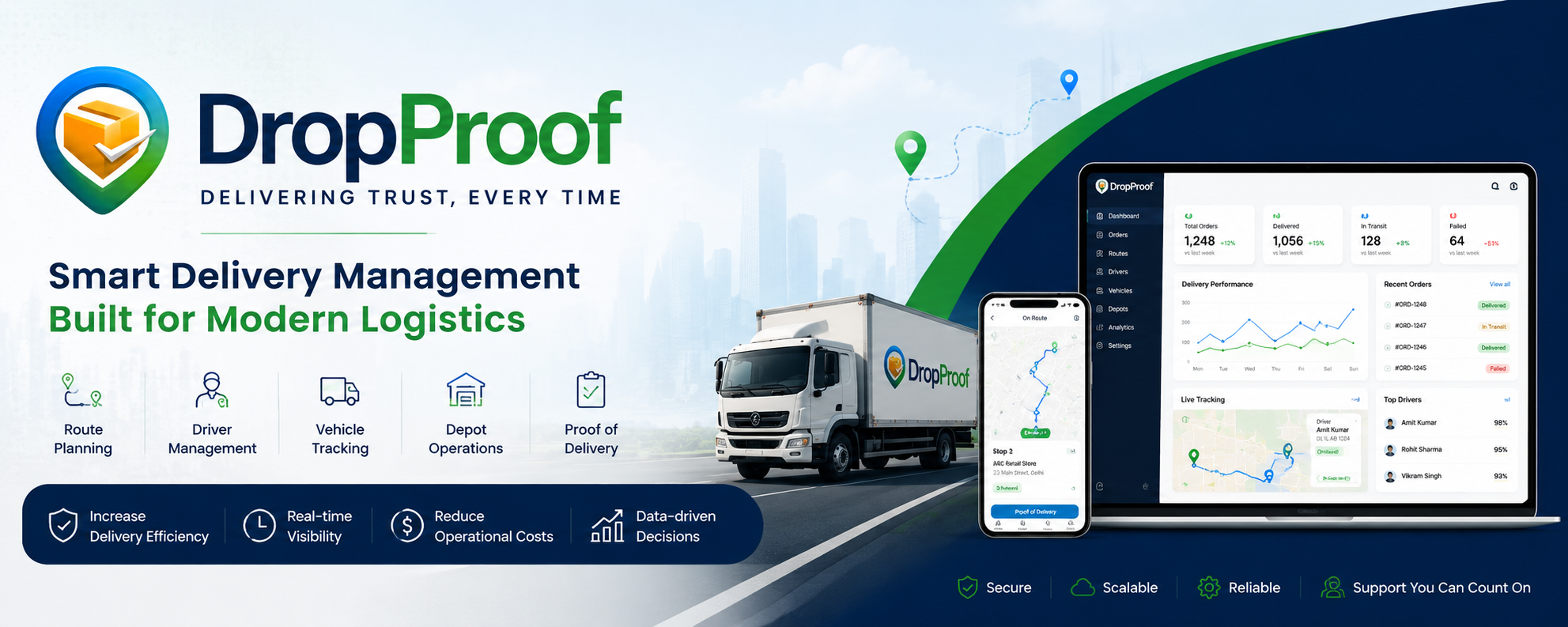
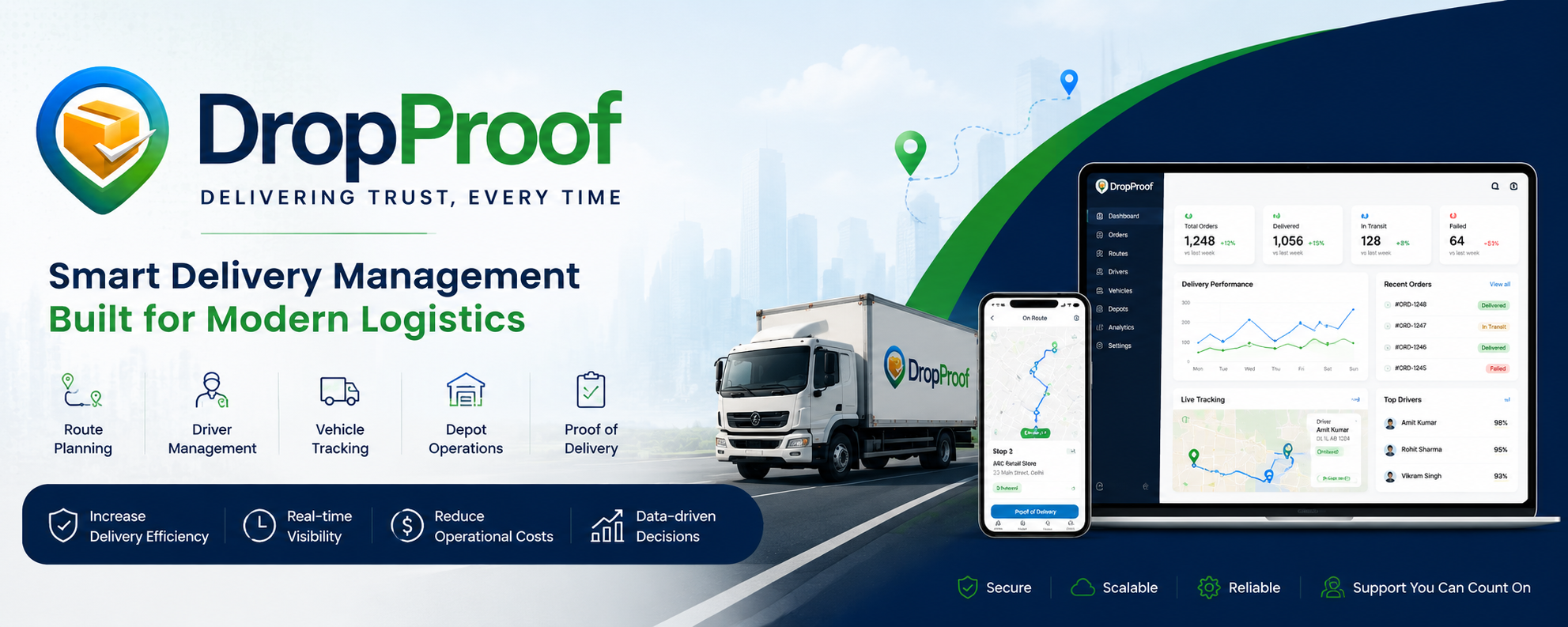
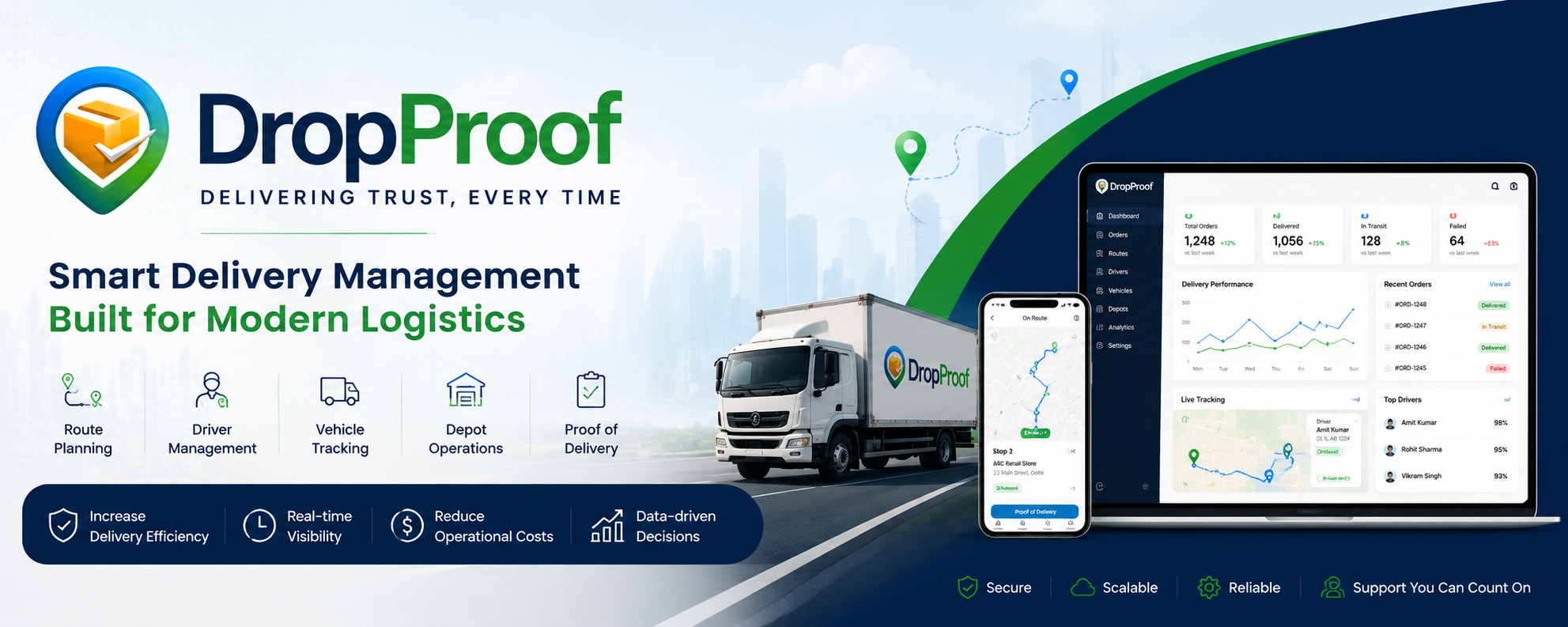
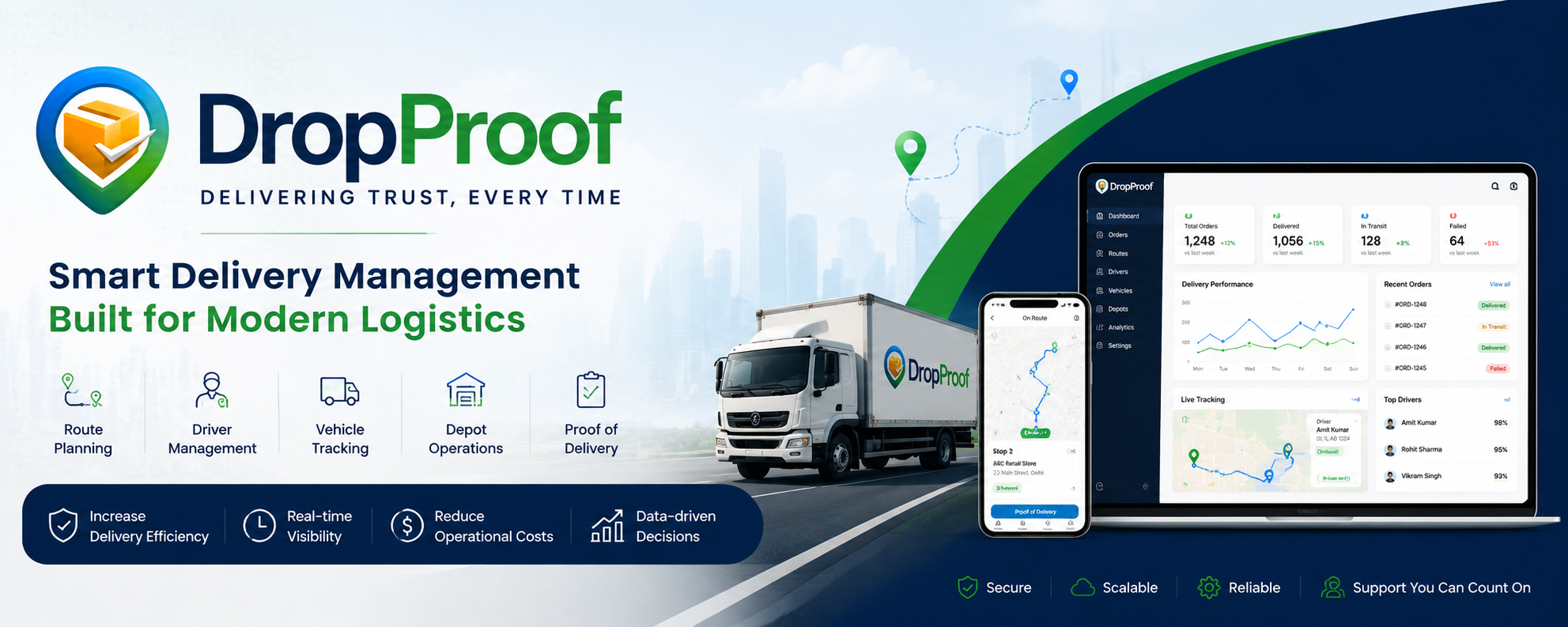
1. DropProof
Best for: Ready-to-use end-to-end delivery management.
DropProof provides a centralized platform for managing delivery operations without requiring a business to build the entire system from scratch.
It provides:
- Order management
- Route planning
- Driver management
- Vehicle management
- Depot management
- Real-time tracking
- Delivery execution
- Digital proof of delivery
- Delivery photos
- Digital signatures
- GPS verification
- Delivery notes
- Reporting
- API integrations
The workflow can be managed through:
Order → Route → Driver → Track → Deliver → Capture POD
Why consider DropProof?
Instead of spending months developing the foundational components of a delivery platform, businesses can use an existing delivery-management system and focus their engineering resources on the parts of their business that are genuinely unique.
DropProof can be particularly useful for businesses that need a structured delivery workflow without taking on the full cost and maintenance burden of a custom application.
2. Onfleet
Best for: Last-mile delivery management.
Onfleet provides tools for dispatching, route management, driver tracking, customer communication, and delivery operations.
It can be an alternative for businesses that need a ready-made last-mile delivery platform rather than building one internally.
3. Locus
Best for: Logistics optimization and route planning.
Locus focuses on logistics technology, route optimization, and last-mile execution.
It can be relevant for organizations with more complex logistics and optimization requirements.
4. LogiNext
Best for: Logistics and delivery optimization.
LogiNext provides logistics technology covering route optimization, fleet operations, and delivery management.
It can be considered when a business wants broader logistics capabilities without building the underlying system itself.
5. FarEye
Best for: Delivery orchestration and enterprise logistics.
FarEye provides technology focused on transportation, delivery orchestration, and logistics visibility.
It can be relevant for larger organizations with complex delivery requirements.
6. Shipsy
Best for: Logistics management and orchestration.
Shipsy provides technology for logistics and transportation operations.
It can be evaluated by businesses looking for an existing logistics platform instead of developing their own system.
7. Track-POD
Best for: Digital proof of delivery.
Track-POD focuses on electronic proof of delivery and digital delivery documentation.
It can be useful when a business doesn't need to build a complete delivery platform but wants to digitize one important part of the workflow.
Custom Delivery App vs Ready-Made Platform
| Factor | Custom-Built App | Ready-Made Platform |
|---|---|---|
| Initial development | High | Lower |
| Time to launch | Longer | Faster |
| Customization | Very high | Depends on platform |
| Maintenance | Your responsibility | Provider-managed |
| Infrastructure | Your responsibility | Usually included |
| Updates | Your team | Provider |
| Route planning | Build/integrate | Available |
| Driver management | Build/integrate | Available |
| Real-time tracking | Build/integrate | Available |
| Digital POD | Build/integrate | Available |
| Scalability work | Your responsibility | Platform-dependent |
Exact capabilities and customization options vary by provider.
How Much Does a Custom Delivery App Really Require?
The visible application is only one part of the project.
A complete delivery system may require:
Backend
- APIs
- Database
- Authentication
- Authorization
- Business logic
- Notifications
- Integrations
Driver Application
- Login
- Assigned deliveries
- Navigation
- Delivery status
- Photos
- Signatures
- GPS
Admin Dashboard
- Orders
- Routes
- Drivers
- Vehicles
- Tracking
- Reports
- POD
Infrastructure
- Hosting
- Database infrastructure
- Storage
- Monitoring
- Security
- Backups
Ongoing Engineering
- Bug fixes
- Updates
- New features
- Security patches
- Performance improvements
What starts as a simple delivery app can quickly become a significant software project.
When Does Building Custom Make Sense?
A custom application can be the right choice when your delivery workflow is genuinely unique.
For example:
A logistics business has specialized operational rules that cannot be supported by existing platforms.
In that case, building custom software may provide the flexibility required.
But if your requirements are primarily:
Orders + Routes + Drivers + Tracking + POD
you may not need to build the entire system yourself.
When Is a Ready-Made Platform Better?
A ready-made platform can make sense when:
- You need to launch quickly
- Your workflow is relatively standard
- You don't have a large engineering team
- You want to reduce development overhead
- You need existing delivery features
- You want ongoing platform updates
- You want to avoid maintaining infrastructure
Custom Development vs DropProof
A custom delivery application might require:
Planning → Design → Development → Testing → Deployment → Maintenance
With DropProof, the workflow can be:
Configure → Add Orders → Assign Drivers → Track → Deliver → Capture POD
This can allow businesses to focus their resources on their core operations rather than rebuilding standard delivery infrastructure.
What Should You Look for in a Delivery Platform?
1. Order Management
Can you create, import, assign, and manage delivery orders?
2. Route Planning
Can dispatchers organize delivery stops and routes?
3. Driver Management
Can your team manage drivers and assignments?
4. Vehicle Management
Can vehicles be connected to drivers and routes?
5. Depot Management
Can multiple operating locations be managed?
6. Real-Time Tracking
Can operations teams monitor delivery progress?
7. Digital POD
Look for:
- Digital signatures
- Delivery photos
- GPS verification
- Timestamps
- Delivery notes
8. Integrations
Can the platform connect to your existing:
- ERP
- WMS
- CRM
- eCommerce platform
- Order-management system?
9. Reporting
Can you measure:
- Delivery performance
- Driver performance
- Route performance
- Failed deliveries
- POD completion
Custom Delivery App Alternatives Comparison
| Platform | Delivery Management | Route Planning | Driver Management | Tracking | Digital POD |
|---|---|---|---|---|---|
| DropProof | ✅ | ✅ | ✅ | ✅ | ✅ |
| Onfleet | ✅ | ✅ | ✅ | ✅ | ✅ |
| Locus | ✅ | ✅ | ✅ | ✅ | ✅ |
| LogiNext | ✅ | ✅ | ✅ | ✅ | ✅ |
| FarEye | ✅ | ✅ | ✅ | ✅ | ✅ |
| Shipsy | ✅ | ✅ | ✅ | ✅ | ✅ |
| Track-POD | Focused | ✅ | ✅ | ✅ | ✅ |
Capabilities can vary by product, plan, and configuration.
Custom App vs DropProof: Which Is Better?
There isn't one answer for every business.
Build Custom If:
You have unique workflows that require complete control over the technology.
Choose DropProof If:
You need a ready-to-use delivery platform covering:
- Orders
- Routes
- Drivers
- Vehicles
- Depots
- Tracking
- Delivery execution
- Digital POD
The key question isn't:
"Can we build it?"
Your developers probably can.
The better question is:
"Is building and maintaining it the best use of our time and resources?"
Who Can Benefit From a Ready-Made Delivery Platform?
🚚 Logistics Companies
Launch structured delivery operations without building an entire platform.
📦 Distribution Businesses
Digitize order-to-delivery workflows.
🏭 FMCG & Wholesale Businesses
Manage recurring deliveries and multiple delivery locations.
🛒 E-commerce Delivery Teams
Manage last-mile delivery without developing an application from scratch.
🚛 Growing Fleets
Move from spreadsheets and manual processes to centralized delivery management.
Final Thoughts
Building a custom delivery application gives you maximum control, but it also means taking responsibility for development, infrastructure, security, maintenance, updates, and future feature development.
For businesses with highly unique requirements, that investment can make sense.
But if your main requirements are:
Order → Route → Driver → Track → Deliver → POD
a ready-made delivery-management platform can provide those capabilities without requiring you to build the entire system yourself.
DropProof is designed to help businesses manage this workflow from one platform.
Build your competitive advantage—not another delivery backend.
Plan routes. Manage drivers. Track deliveries. Capture digital proof.
Explore DropProof → Book a Demo